
5 Steps to Break Free from the Binge-Restrict Cycle
Bingeing or overeating can cause a lot of stress, guilt, shame and physical discomfort. For many people, the natural response is to try to “fix” it by restricting food intake afterwards or cut out the foods you tend to binge on.
But restricting can actually make bingeing worse. In fact, restriction is one of the biggest predictors of binge-like behavior.
While this cycle can feel incredibly hard to break, it is possible to end it. Breaking the cycle is essential to ending bingeing and overeating for most people.
Disclaimer: This post is not medical advice and does not diagnose or treat binge eating disorder. If you suspect you may have binge eating disorder, you deserve support. Schedule a free discovery call to see if 1-1 counseling is the right fit for you.
Overeating vs. Bingeing
Before we get into the binge-restrict cycle, it’s important to understand some terminology.
What is a Binge?
According to the DSM-5 (a set of criteria used for diagnosing mental illnesses including eating disorders), a binge eating episode is defined as eating a large amount of food during a specific time period and feeling a lack of control over eating.
A binge can also include:
- Eating faster than normal.
- Eating until you feel uncomfortably full.
- Eating large amounts of food when you’re not actually hungry.
- Eating alone because you’re ashamed of how much you’re eating.
- Feeling disgusted and guilty after overeating.
It’s also often associated with a feeling of “numbing” or not even realizing how much you’re eating. Most people who binge do so in secret or when they’re alone
What is overeating
Bingeing has become a common term to describe an overeating experience. While these two things are different (binge has a technical definition as described above), the reality is, overeating can still be just as distressing.
Eating more than feels comfortable, feeling out of control around certain foods, and feeling like you can’t stop eating even when you’re full can feel just as bad.
It can lead to the same guilt and shame spiral. It can still keep you stuck in a cycle of restricting and overeating. If it feels distressing, it’s something to address.
What is the Binge-Restrict Cycle?
The binge-restrict cycle is a pattern in which you overeat to the point of discomfort, guilt, and shame, and then as a response choose to restrict your overall intake by skipping meals, eating ‘clean,’ cutting calories, or cutting out certain foods.
Although you might be able to cut calories or certain foods for some time, eventually something triggers overeating again. And the cycle continues.
The restrict-binge cycle is super common among dieters. Think back to the last time you dieted, cut carbs or sugar, or followed a low calorie diet. Did you end up breaking your diet and eating a lot of some of the foods that were previously off limits?
If you’re nodding along, you’ve probably experienced the feelings of shame and negative self-talk that accompany this. You might have even said to yourself, “well, I’ll be good tomorrow, so I better eat the rest of this now.”
This negative self-talk and the idea that you’ll be better tomorrow actually perpetuates the cycle because it signals to your brain that more restriction is coming.
And it’s well established that restriction increases the chances of overeating or bingeing.
Stages of the Binge-Restrict Cycle
The binge-restrict cycle has five stages. You can enter the cycle anywhere, and oftentimes you’ll enter it at different places depending on the day or season of life.
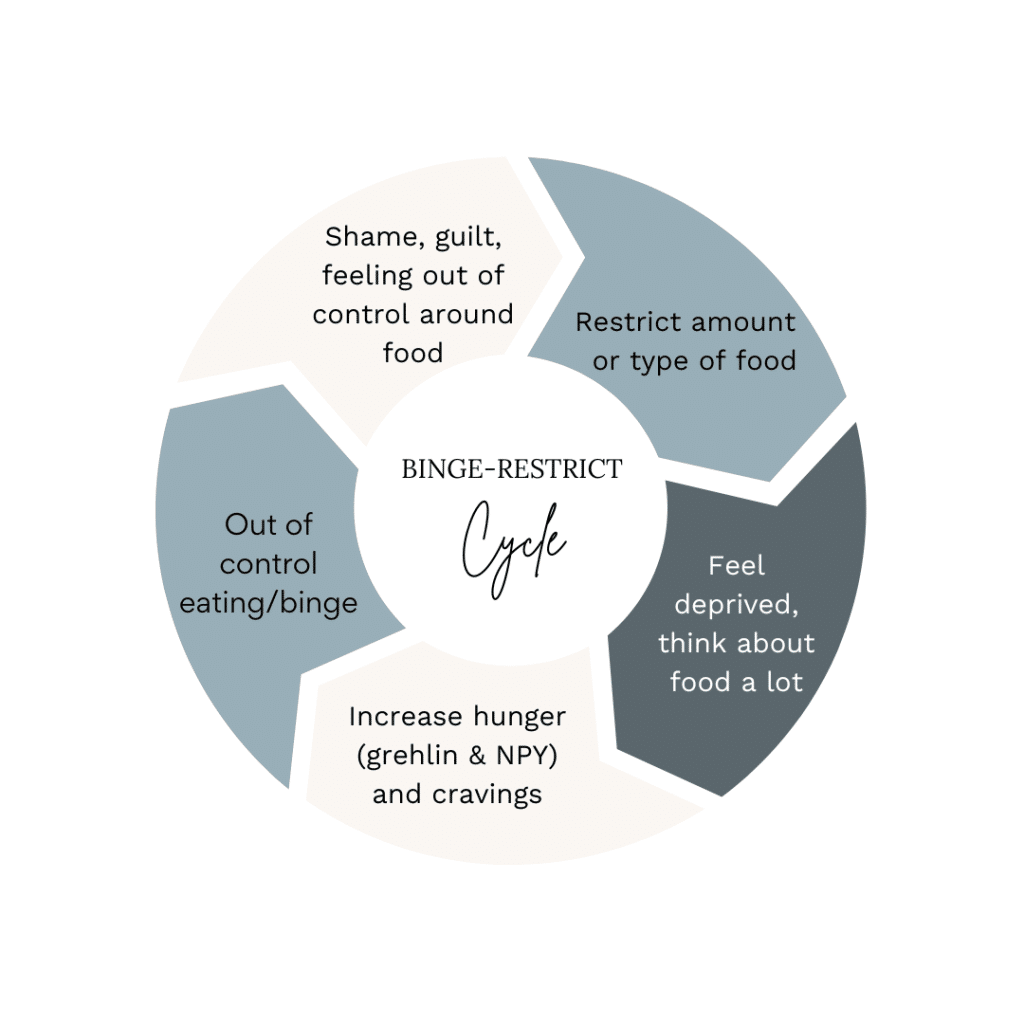
Stage 1: Guilt, shame, and feeling out of control
Guilt and shame often go hand-in-hand, although they’re two different feelings. You may feel guilty for eating something you believe you shouldn’t or eating more than you should have.
That’s usually followed by feeling of shame and thoughts like:
- What’s wrong with me?
- Why can’t I be more in control?
- Why don’t I have more willpower
- No wonder I can’t lose weight
And many other negative thoughts about yourself.
Stage 2: Restriction
Restriction is a common response to feeling badly about your body or feeling out of control around food. Restriction can include reducing portions (common among calorie counters), skipping meals, or cutting out certain foods.
You may also find yourself mentally restricting foods. With mental restriction, you may allow yourself to eat certain foods but feel like you shouldn’t. For example, you might eat pasta for dinner but still categorize that as a “bad” food and feel like it’s something you need to make up for.
Just like physical restriction, mental restriction can produce feelings of shame, guilt, and loss of control around food. In fact mental restriction can lead to overeating just as much as physical restriction.
The restriction phase can last anywhere from days or weeks to over a year. You may even feel a sense of pride or be motivated by your ability to control your eating at this stage.
Stage 3: Deprivation
Restriction eventually leads to feeling deprived. If you’re restricting calories, you might feel tired, low energy, and preoccupied by food. If restriction is more focused on specific foods like desserts or carbs, you probably spend a lot of time negotiating with yourself about when you’ll eat the food (or how you’ll earn it).
Other symptoms of deprivation include obsessively browsing recipes online and even feeling jealous of people who do eat the foods you’re restricting.
It’s also common to skip social activities because you don’t feel like you can “control” yourself when you’re out. Even if you don’t skip the event, you might worry and obsess about the food the whole time.
If you find that you’re preoccupied with food, check out our article about how to stop thinking about food all the time.
Stage 4: Intense cravings
This is where restriction really starts to take a toll. You feel like you’re constantly fighting the urge to eat. Whether that’s just eat more in general or a specific food that’s been off limits. You may find it difficult to focus because you’re consumed with thoughts about food.
You might also notice that no matter what you eat, you don’t feel satisfied and can’t stop thinking about your next meal.
Want to actually conquer your cravings instead of fighting against them? Listen to my free Quiet the Food Noise podcast series, where I share the exact steps to quiet cravings, stop obsessing and finally feel in control around all foods.
Stage 5: Overeating/binging
Eventually, the restriction and cravings become too much to handle, and you give in.
The primal part of your brain takes over, and you find yourself eating in an out-of-control way. Somehow, the cookies make it into the house and call you name.
When you eventually give in, it probably feels really impulsive. It may even feel like emotional eating. You eat past fullness or in a way that doesn’t feel good in your body.
When this happens, you tell yourself that this is the last time you will eat any of these “off-limits” foods. The “eff-it” mentality often kicks in with thoughts like:
- I’ve already messed up, I better eat it all now because I’ll be better tomorrow
- Well, I’m a failure, might as well keep eating
- I knew I couldn’t eat just one cookie
And this leads to eating even more. It can feel nearly impossible to stop even if you know you don’t need to keep eating. But once you stop eating, you’re flooded with feelings of shame and guilt, and the binge-restrict cycle starts over.
This cycle is not a moral failure
When you’re stuck in the binge-restrict cycle, it just feels like there’s something wrong with you. You probably wish you could just be normal around food, but the binge reiterates to your brain that the only path forward is to restrict again.
I want you to know this: there isn’t anything wrong with you. The problem is the cycle repeats itself and in order to break it (and ultimately stop the binge), it’s important to understand the reltionship between restricting, bingeing, and guilt/shame.
Hunger Hormones can Trigger a Binge
People binge for a number of reasons, but one of the most common reasons is related to restriction. To understand why you binge, you need to know about the hunger hormones ghrelin and neuropeptide Y (NPY).
Ghrelin is a hormone that causes you to feel hungry. When you eat enough, ghrelin production is suppressed until it’s time for your next meal. When it’s time to eat again, ghrelin is released and tells your brain to seek out food.
However, when you’re restricting how much you eat, ghrelin is continually released, leading to constant hunger. That hunger can compound, too.
Think back to the last time you were trying to cut calories or skipped a meal. Were you thinking about food a lot? Thinking about food is actually a sign of hunger.
And ghrelin isn’t the only hormone that causes you to feel hungry or want food. NPY is a hormone that is released between meals. It also increases the desire to eat, especially foods rich in carbohydrates.
Here’s the thing: your body has evolved to survive, and it can’t tell the difference between a diet and actual starvation. In caveman days, ignoring hunger could mean death.
When hunger hormones are constantly released because you’re not eating enough, the caveman brain turns on. This causes you to eat faster and crave foods that provide quick energy and/or a lot of calories. This is why you crave things with sugar and fat in them.
And that’s exactly why you all of a sudden find yourself eating a tub of ice cream without even realizing it. It’s not because you don’t have enough willpower.
Dieting and the Binge-Restrict Cycle
Dieting is inherently restrictive and can be the reason you’re the binge-restrict cycle. When you diet, you probably cut back on your portions, stop eating certain foods, maybe skip meals, or have rules about what kind of foods you can eat.
Cutting calories significantly and foods is a form of restriction, which leads to the release of hunger hormones. This causes you to feel hungry and crave energy-dense or carb heavy foods like cookies, chips, pasta, and pizza.
And that’s not all. The mental restriction with dieting can lead to an obsession with food. If you can’t stop thinking about food, you are more tempted to eat more of it and feel out of control around it.
5 Ways to Break Free from the Binge-Restrict Cycle
If you’re stuck in the binge-restrict cycle, you may feel like it’s impossible to break free from it. But it is possible to stop.
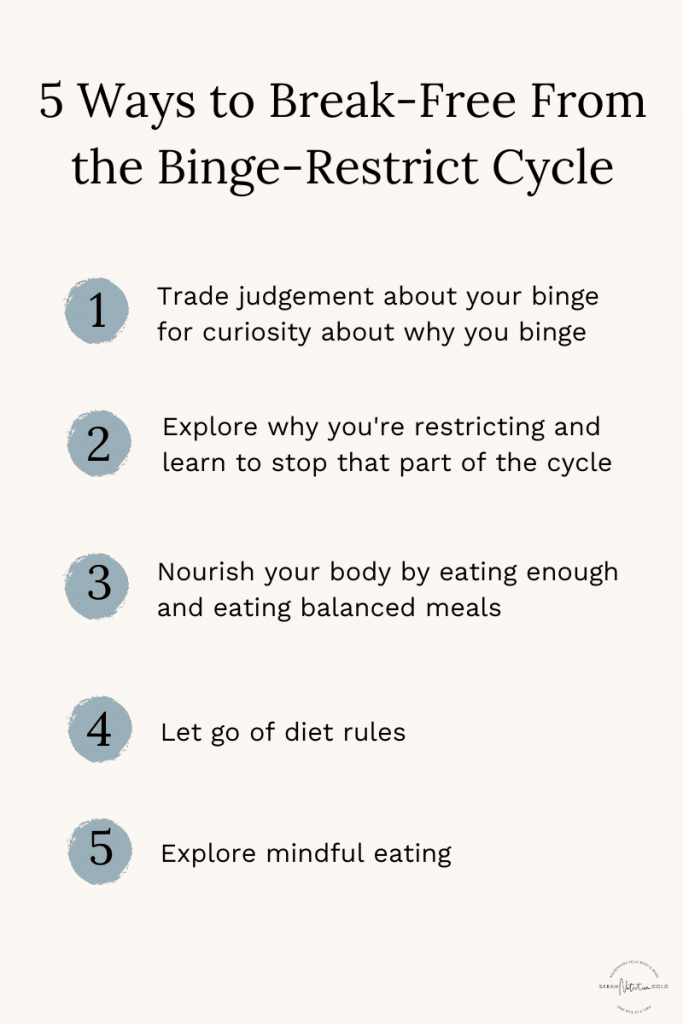
Trade Judgment for Curiosity
One of the most important steps in breaking this cycle is to get curious about why you binge. Most people tend to go straight to criticism and negative self-talk (“I’m such a failure and have no willpower”).
Instead of judgment, ask yourself:
- have I been restricting calories or undereating?
- did I get over hungry?
- am I restricting certain foods?
- was I using food to self-soothe or as a reward?
Answering these questions gives you information on what’s at the root of the binge. And instead of trying to “fix” it with more restriction, you can address the real cause. This is how real behavior change begins.
If answering these questions feels hard or you’re not sure what’s at the root, getting the help of a professional who specializes in binge eating can be helpful. Learn more about how I can support you here.
Explore Why You’re Restricting
One of the best ways to break the binge-restrict cycle is to stop restricting. But given the messages about weight and health surrounding us, this is easier said than done.
To stop restricting, it’s important to understand why you’re doing it in the first place. For many people, restriction is driven the desire for weight loss or a fear of weight gain.
This makes sense because we’re surrounded by messages telling us we must shrink ourselves to be worthy. The irony is, being stuck in the restrict-binge cycle can make reaching a healthy weight for you even harder.
This is why working with a professional who can help you uncover core beliefs about food, weight, and self-worth that are keeping you stuck, is incredibly helpful in this process.
Nourish Your Body
Your body needs energy to function properly. If you’re restricting your intake, either by reducing portion sizes or eliminating certain macronutrients (like carbohydrates), you won’t get the nutrition you need and will likely experience cravings later in the day.
To ensure your body is getting the fuel it needs, try to eat something every three to four hours. If there are more than four hours between your main meals, add a balanced snack.
It’s also important to include a balance of all three macronutrients (carbohydrates, protein, and fat) at each meal. You might think it’s helpful to avoid certain carbs or fat, but that could be what’s perpetuating the cycle.
Along with nourishing your body, reconnecting with your body’s hunger and fullness cues empowers you to know how much to eat for YOUR body to avoid setting yourself up for a binge.
Let Go of Dieting Rules
Until you give yourself full permission to eat all foods, you’ll stay stuck in the binge-restrict cycle. This is because by making certain foods off limits (or labeling them as “bad”), you’re giving them all the power. You’ll be more likely to gravitate toward them when you’re hungry or stressed.
The key to breaking free from the binge-restrict cycle is making peace with food and letting go of diet rules. Read more about how to break free from the food rules that keep you stuck in the binge-restrict cycle.
Explore Mindful Eating
Do you ever sit down to eat a meal only to spend the entire meal looking at your phone or watching TV? If so, you might not be getting as much satisfaction from the meal as you could.
Mindful eating helps you get more from the food experience and connect with your body to know when you’ve had enough to eat.
Try putting away the technology and instead engaging all your senses as you eat. Notice how the food smells, tastes, and feels in your mouth. By paying more attention to your food, you’ll get more satisfaction from the meal, which could help prevent future binges.
Why Nighttime Feels Hard
If you struggle with binge eating and overeating, nighttime is probably a particularly tough time for you. Many people find they can ‘keep it together’ during the day and then it all falls apart at night.
If that’s you, there’s nothing wrong with you, and the strategies outlined in this article will help alleviate this. You may want to read Why You Binge at Night Plus Proven Tips to Stop to understand why nighttime feels extra hard.
Frequently Asked Questions
How does emotional eating relate to bingeing?
Stress, loneliness, sadness, overwhelm, and other emotions can trigger a binge. But if learning to cope with your emotions hasn’t helped reduce binge eating, there’s a good chance restriction (either physical, mental, or both) is still the cause of both your emotional eating and binge eating.
Can Intuitive Eating Help Stop Restricting and Bingeing?
Intuitive eating can be a very helpful strategy for many people to stop the restrict-binge cycle.
Intuitive eating helps you reject dieting and food rules, learn to connect with your body’s inner cues of hunger, fullness, and satisfaction, practice gentle nutrition (to nourish your body), make peace with all foods, and cope with emotions in productive ways (which often is without food).
All of these steps are essential to ending the restrict-binge cycle.
Final Thoughts
Breaking free from the binge-restrict cycle isn’t easy, but it is possible. By ditching dieting and instead giving yourself full permission to eat all foods, you’ll take away the power that certain foods once had over you.
Ready to finally put an end to the binge-restrict cycle? The best place to start is by listening to my free private podcast series: Quiet the Food Noise.



4 Comments